Himmel Street
The Book ThiefHimmel Street is the Molching street where Liesel Meminger is taken after the chaotic separation from her mother and where the central household of the novel is formed. Its name means “Heaven,” an irony the narrative steadily deepens: the street offers shelter, family, books, and acts of solidarity, yet it is also exposed to Nazi power, air raids, persecution, and finally annihilation. Himmel Street is therefore not merely a setting but the novel’s pressure chamber, where ordinary domestic routines are forced to coexist with the historical violence surrounding them.
Setting and Material Conditions
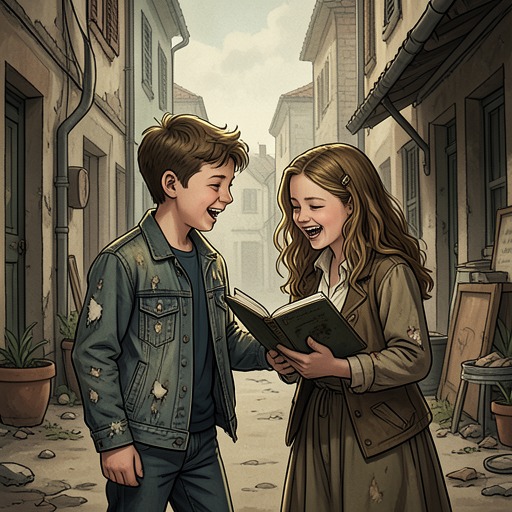
Himmel Street lies in the town of Molching, beyond the outskirts of Munich. Liesel first sees it through the glass of the foster-care vehicle as Frau Heinrich tells her that she is approaching her new home. The accompanying image presents buildings that seem glued together: small houses and apartment blocks with a nervous, precarious appearance, their surroundings covered by murky snow. The street’s physical character immediately establishes a world of poverty, compression, and unease rather than security.
The Hubermanns live in one of Himmel Street’s small, boxlike houses. It contains only a few rooms and a kitchen, while the outhouse is shared with neighbors. A flat roof and a shallow basement used for storage complete the arrangement. In 1939, the basement’s inadequate depth is merely an architectural deficiency; in 1942 and 1943, once air raids begin, it becomes a matter of survival. The residents must run down the street to a better shelter, making the neighborhood’s boundaries part of the geography of danger: home is close enough for daily life, but not deep or safe enough to protect its inhabitants from war.
Domestic Life and Hidden Social Theater
Himmel Street becomes the arena in which Liesel’s new family is made. Her arrival is marked by hunger, frostbitten hands, thin limbs, and the uncertainty of a child who cannot remember her father and understands only that he was labeled a communist. The street thus receives her not as a secure origin but as a lost child carried into a foreign place among foreign people. Within the Hubermann house, Rosa Hubermann’s furious profanity dominates the first evening, while the cramped rooms make every act of adjustment immediate and visible.
The house at 33 Himmel Street later becomes the concealed destination of Max Vandenburg. In November 1940, Max arrives in its kitchen at twenty-four, exhausted and shaking, with clothes that seem to weigh him down. His presence transforms the address from a foster home into a site of illegal protection. The family’s response is significant precisely because fear does not produce hysteria: despite the danger of a Jewish man appearing at their residence in the birthplace of Nazism, the household resists panic and begins the work of hiding him.
That protection requires Himmel Street to function as a stage. Max cannot remain openly present, and Hans Hubermann must continue playing the accordion several times a week because the family needs the money and any sudden change might arouse suspicion. The household’s life has altered radically, yet its members must behave as though nothing has happened. Public normality becomes a daily performance, and the street outside becomes the front stage against which the basement and interior rooms acquire their dangerous secrecy.
Thresholds, Raids, and Exposure
The door of 33 Himmel Street repeatedly represents the unstable boundary between concealment and discovery. At one critical moment, a seven-punch knock is hammered into the door, and there is no longer time to move anyone elsewhere. The command to open up turns an ordinary household entrance into a point of crisis. The address is no longer simply where the Hubermanns live; it is where the consequences of their moral choice may be exposed.
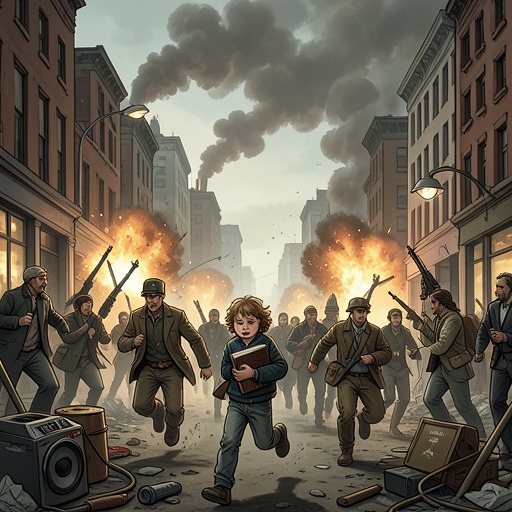
Air raids similarly convert the street into a communal threshold. When the sirens howl, people run, hobble, and recoil from their houses, carrying whatever they value most. Liesel carries her books between her arm and ribs. Frau Holtzapfel struggles with a suitcase, while Hans, having forgotten even his accordion in the rush, turns back to rescue it from her. The procession reveals the neighborhood’s shared vulnerability, but it also distinguishes its inhabitants through the objects they save: books, photographs, boxes, instruments, and the accumulated remnants of private lives.
Himmel Street’s wartime public life also brings its residents into direct proximity with the persecution of Jews. On Munich Street, they watch prisoners being forced down the road. The Jewish men appear as a catalog of colors, with starving faces, dirt molded to their bodies, and soldiers driving them through brief bursts of forced running before they return to a malnourished walk. Hans watches above the crowd, while Liesel looks through gaps and over shoulders. Himmel Street is not isolated from the machinery of Nazi violence; its residents are made witnesses, and their location places them within the route by which that violence becomes publicly visible.
Destruction and Narrative Significance
The street’s destruction fulfills the threat that its shallow shelter and exposed houses have long embodied. In the final bombing, the bombs fall while the residents sleep, and Himmel Street is flattened. Houses are splashed from one side of the street to the other, and a framed photograph of the Führer lies smashed on the floor while its subject continues to smile. The image joins political authority to physical ruin: the face of power survives symbolically amid the wreckage, even as the people beneath it do not.
The dead include Rudy Steiner, Mama and Papa, Frau Holtzapfel, Frau Diller, and Tommy Müller. The roll call of streets—Munich, Ellenberg, Johannson, Himmel—places the neighborhood within a wider pattern of bombardment, but Himmel Street receives the most intimate treatment because the reader has inhabited its rooms, thresholds, routines, and secrets. Its destruction is consequently more than a military consequence. It erases the physical community that sheltered Liesel and Max, while preserving the moral record of what occurred there.
Himmel Street’s deepest irony lies in the collision between its heavenly name and its earthly history. It is a place of poverty, profanity, fear, and surveillance, yet also of foster care, friendship, reading, and resistance to dehumanizing labels. The street gathers people whom Nazi ideology classifies as German, Jewish, communist, poor, or politically obedient, then reveals the human relations that those categories cannot contain. Its final disappearance makes memory the only surviving form of place: Himmel Street becomes the lost geography through which Liesel’s education in words, loyalty, grief, and responsibility can still be told.